Men’s Gay Swimwear Trends Are Becoming More Popular Worldwide
Men’s swimwear has changed dramatically. For decades, much of the mainstream market gave men a relatively limited selection: board shorts, trunks, traditional swim briefs, and a handful of athletic styles. Today, that picture is very different.
One of the most interesting influences on this transformation has come from gay men’s swimwear fashion. Gay beach and pool culture has long embraced body-conscious swimwear, bright colors, creative cuts, and designs that challenge traditional ideas about what men are supposed to wear. Many of those styles are now moving well beyond specifically gay markets and becoming part of a much broader international swimwear movement.
Bikinis, thongs, G-strings, micros, ultra-micros, contour pouches, gender-fluid designs, and other once-niche styles are increasingly visible wherever men feel comfortable experimenting with fashion.
The result is a much larger definition of men’s swimwear.
Gay Men Have Helped Push Men’s Swimwear Forward
Gay men certainly did not invent revealing men’s swimwear. Brief swimsuits have existed for generations, and in many parts of Europe, South America, and elsewhere, small men’s swimsuits have never carried the same stigma they sometimes acquired in North America.
Gay beach culture, however, has been particularly influential in turning swimwear into a form of personal fashion and self-expression.
At gay beaches, resorts, cruises, pool parties, and LGBTQ+ destinations, men have often had greater freedom to experiment. Instead of asking whether a swimsuit is too small, too colorful, too feminine, or too revealing, the emphasis is frequently on whether the wearer likes it.
That attitude helped create an ideal environment for new designs.
Today, many styles associated with gay swimwear are being worn by men across different sexual orientations. A bikini is simply a bikini. A thong is simply another swimsuit option. The garment itself does not determine the wearer’s sexuality.
The Men’s Bikini Continues to Grow
The bikini brief remains one of the easiest ways for a man accustomed to trunks or shorts to experiment with smaller swimwear.
Traditional men’s swim briefs established the basic concept: close-fitting fabric, high freedom of movement, and no unnecessary material. Modern bikinis take that idea considerably further.
They may feature narrower sides, higher-cut legs, lower fronts, smaller rear panels, or more anatomically shaped pouches.
Some look athletic. Others are deliberately sexy.
And increasingly, designers are borrowing elements from women’s bikini fashion. Instead of maintaining rigidly separate male and female silhouettes, designers can take inspiration from both.
That creates considerably more variety.
Thong Swimwear Is Becoming More Visible
The men’s thong is another style that has moved far beyond its former niche.
A thong combines front coverage with minimal rear coverage, creating an exceptionally small swimsuit without requiring the wearer to give up support in front.
Gay men have helped normalize this look in many beach and resort environments. As men see other men confidently wearing thongs, the style becomes less unusual.
That visibility matters.
Fashion changes partly through repetition. Something that initially attracts attention can eventually become ordinary when enough people begin wearing it.
The same thing happened with men’s swim briefs. The thong may be following a similar path, although acceptance still varies considerably by country, beach, resort, and individual venue.
G-Strings Take Minimal Swimwear Even Further
For swimmers who want even less coverage, the G-string represents another step.
A men’s G-string generally retains enough material in front to function as swimwear while reducing the sides and back to extremely narrow straps.
This is not going to become everyone’s swimsuit—and it doesn’t need to.
One of the biggest changes in men’s swimwear is precisely that men no longer have to agree on one acceptable style.
One man can wear board shorts while the man beside him wears a bikini and another chooses a G-string. Men’s swimwear is becoming a spectrum rather than a uniform.
Micro Swimwear Is Creating an Entire New Category
Perhaps the most dramatic trend coming from specialty men’s swimwear is the rise of the micro swimsuit.
Micro designs ask a simple design question:
How little fabric is actually necessary to create a functional swimsuit?
The answers have produced an extraordinary range of designs.
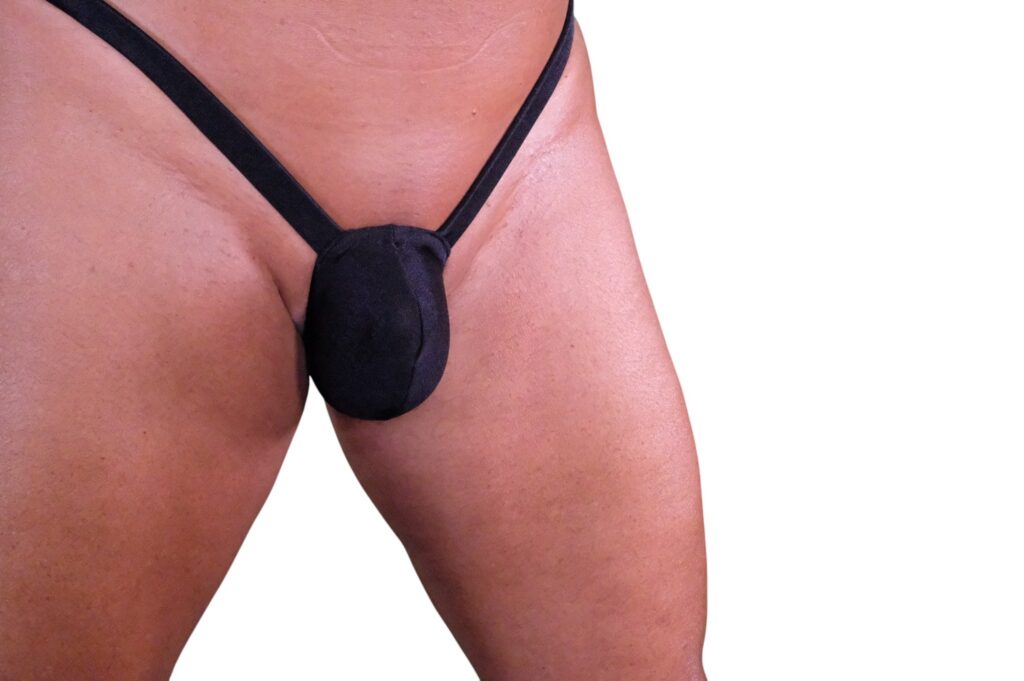
Micro bikinis may have extremely narrow sides and compact fronts. Micro thongs combine tiny pouches with minimal rear coverage. Some designs reduce the swimsuit almost entirely to the portion necessary for coverage.
These swimsuits intentionally make the body the central feature.
For confident wearers, that is exactly the attraction.
Ultra-Micro Swimwear Pushes the Boundary Again
Micro swimwear inevitably led to ultra-micro swimwear.
The distinction isn’t governed by a universal industry standard. Generally, however, ultra-micro describes designs that take minimal coverage to an extreme while still being intended to function as swimwear.
These designs demonstrate just how far men’s fashion has moved.
For generations, women were offered everything from conservative one-piece swimsuits to tiny string bikinis, while men’s choices were comparatively restricted.
Men are increasingly gaining the same freedom to choose their preferred level of coverage.
Pouch Design Has Become a Major Fashion Element
Another important development is the evolution of the male swimsuit pouch.
Older men’s swimsuits frequently treated the front primarily as a functional area providing support and coverage. Contemporary designers increasingly make it an important visual component of the garment.
Pouches can be rounded, contoured, compressed, flattened, enhanced, minimized, or anatomically shaped.
Some suits emphasize the natural male silhouette. Others intentionally minimize it.
This has produced categories such as:
- anatomical contour pouches
- micro pouches
- pouch-only inspired designs
- compression fronts
- minimal-bulge designs
- flat-front designs
- gender-neutral fronts
- feminizing and MTF-inspired silhouettes
The important development isn’t any single style. It is the existence of choice.
Men can now decide how they want their bodies presented instead of simply accepting whatever shape a conventional swimsuit creates.
Gender-Fluid Swimwear Is Expanding the Market
One of the newest developments is the growth of gender-fluid swimwear.
Historically, swimsuits were marketed through a very simple division: men’s suits were designed one way and women’s suits another.
That boundary is becoming much less rigid.
Some men want masculine-looking swimwear. Some want something feminine. Others enjoy moving between the two.
Trans women, nonbinary people, femboys, feminine men, and gender-fluid wearers have also encouraged designers to rethink what a swimsuit can accomplish.
As a result, we’re seeing more garments combining traditionally male construction requirements with traditionally feminine silhouettes.
MTF-Inspired Swimwear Is Becoming More Sophisticated
Another specialized category is swimwear intended to create a more feminine appearance for people with male anatomy.
Different garments approach this in different ways.
Some provide compression. Some support tucking. Others use shaping panels or specialized construction to reduce the appearance of a traditional male bulge.
The objective can range from subtle smoothing to creating a dramatically more feminine silhouette.
For trans and gender-diverse wearers in particular, having more choices can make beaches, pools, and vacations more comfortable and enjoyable.
And some cisgender men simply enjoy the aesthetic.
Sheer and Semi-Sheer Designs Remain Part of the Extreme Market
Specialty men’s swimwear also includes sheer and semi-sheer fabrics.
These can range from subtly translucent materials to garments intended primarily for private pools, adult resorts, or other appropriate settings.
Anyone experimenting with these designs should understand that standards regarding exposure differ enormously between venues and jurisdictions. A suit appropriate for an adults-only resort may not be appropriate at a public family beach.
The growth of extreme swimwear doesn’t eliminate the importance of knowing your surroundings.
Gay Resorts and Pool Parties Remain Fashion Laboratories
Some of the most adventurous men’s swimwear continues to appear first at gay resorts, destination events, pool parties, cruises, and beaches.
These environments can function almost like fashion laboratories.
A new cut appears.
A few adventurous men wear it.
Other people notice it.
Photos and social media spread the style.
Specialty manufacturers develop variations.
Eventually, something that once looked radical begins appearing in more conventional settings.
This is one reason gay fashion can influence the larger men’s swimwear industry.
Social Media Has Accelerated Everything
Twenty years ago, a distinctive swimsuit worn at a beach in Spain might have remained a local trend.
Today it can be seen around the world almost immediately.
Instagram, TikTok, X, Reddit, specialized forums, travel sites, and other online communities allow men’s swimwear styles to cross borders extraordinarily quickly.
A man living somewhere that traditionally favors board shorts can now see what men are wearing in Ibiza, Mykonos, Rio de Janeiro, Miami, Sydney, Sitges, or other beach destinations.
That exposure can change expectations.
Men discover that what seems daring in one community may be completely ordinary somewhere else.
The Straight/Gay Fashion Divide Is Becoming Less Important
Perhaps one of the biggest long-term changes is that swimwear styles themselves are becoming less strongly associated with sexual orientation.
A straight man can wear a thong.
A gay man can wear board shorts.
A bisexual man can wear a Speedo-style brief.
A trans woman can choose a bikini specifically engineered for her anatomy.
A gender-fluid person can choose a swimsuit that changes how their body is visually presented.
The garment doesn’t need to communicate a sexual orientation.
That freedom is helping men’s swimwear expand.
Body Confidence Matters More Than Body Type
Another positive development is the gradual weakening of the idea that revealing swimwear belongs only on one particular body type.
You don’t have to look like an underwear model to wear a bikini.
You don’t need a particular penis size to wear a Speedo.
You don’t need perfectly defined abdominal muscles to wear a thong.
The practical considerations are much simpler: the swimsuit should fit properly, provide the coverage appropriate for the setting, and make the wearer comfortable enough to enjoy himself.
Confidence often develops after wearing smaller swimwear rather than before it.
The first trip across a crowded beach in a tiny bikini can feel intimidating. After several outings, the same swimsuit may feel completely normal.
From Board Shorts to Briefs—and Beyond
For someone interested in experimenting but not ready for an ultra-micro, there is no requirement to jump directly from long shorts to the smallest swimsuit available.
The progression can be gradual:
Trunks → square-cut briefs → traditional swim briefs → bikinis → narrow bikinis → thongs → micro designs → ultra-micros
But even that progression isn’t a rule.
A man might love bikinis and have no interest in thongs. Another might immediately discover that a thong is more comfortable. Someone else may prefer a tiny front with fuller rear coverage.
Choice is the point.
Different Parts of the World Have Different Standards
Although men’s swimwear is becoming more international, regional differences remain important.
Some European and Mediterranean destinations have long histories of men wearing brief swimwear. Brazilian beach culture has its own traditions of body-conscious swimwear. Australian swim culture has long included fitted athletic briefs. In the United States, attitudes can vary tremendously from one beach or pool to another.
Even within the same city, a gay beach, hotel pool, family aquatic center, adults-only resort, and nightclub pool party can have completely different expectations.
Anyone moving toward increasingly revealing designs should therefore consider the particular venue rather than assuming that worldwide popularity means universal acceptance.
Gay Swimwear Is Increasingly Just Men’s Swimwear
This may ultimately be the most important trend.
Styles once specifically marketed as gay men’s swimwear increasingly overlap with the broader men’s fashion market.
Bikinis aren’t inherently gay.
Thongs aren’t inherently gay.
Micro swimsuits aren’t inherently gay.
Bright colors aren’t gay.
Feminine styling doesn’t automatically define someone’s sexuality.
They are fashion choices.
Gay men have nevertheless played an important role in demonstrating that men can be more adventurous about what they wear—and that there is a substantial market for men who want something beyond conventional trunks.
The Future of Men’s Swimwear Is About Choice
The worldwide men’s swimwear market is unlikely to abandon traditional shorts or briefs. Instead, the category is becoming larger.
That is what makes the current period so interesting.
Men can choose athletic Speedo-style briefs, sexy bikinis, thongs, G-strings, micros, ultra-micros, contour pouches, minimal-bulge suits, gender-fluid designs, feminizing silhouettes, or dozens of variations between them.
Some of the most adventurous ideas continue to emerge from gay swimwear culture before crossing into the wider market.
The larger trend is therefore not simply that men’s swimsuits are getting smaller.
It is that men are gaining more freedom to decide what a swimsuit should look like.
For decades, men’s swimwear fashion was largely defined by what men were supposed to wear. The emerging generation of swimwear is increasingly defined by what individual men want to wear.
And that may be the most significant worldwide men’s swimwear trend of all.